
How Do We Inspire the Best and the Brightest to Become Educators?
I was honored to be named in Top Global Teacher Bloggers / CMRubinWorld.com / Global Search for Education http://www.cmrubinworld.com/TGTB. The bloggers on this list have been asked to contribute to Huffington Post’s Education blogs for 2016. This month we look to answer the following highly controversial question “How do we inspire the best and the brightest to become educators?“
– here is my response:
As a Finnish teacher I often end up answering the question: What and how we teachers act so that our school system is in the top of the world. The situation has been analyzed and has come to a conclusion that parts of our strength are f. eg respect of the profession, flexibility of the curriculum, teachers’ high level of education and autonomy of teaching methods. The students are well aware of these strength factors, so I strongly believe in their influence when applying for profession.
How have I experienced those factors? Have we succeeded even today to get the best of students enter in teaching profession?
- In our society education is still appreciated and this shows directly in the number of appliers to teacher education. The first step in applying for the education is sending the application form. The next step is entering the aptitude test – to which only some are called. Those who pass this test are able to start the studies for basic education. For example the Helsinki University takes 120 starters yearly. In 2015 there were 1832 appliers, of which 766 were called for the literary tests. 360 entered the aptitude tests and 120 were chosen. Under 10% of the whole amount.
- Flexibility of the curriculum means that I know which contents belong to different year classes and what my students are meant to learn during the year. With my colleagues we can plan and carry out study modules with the best way we want. And we of course take notice of the current local events. We can also arrange the core contents so that it supports the learning best. The curriculum isn’t a list of things to do it’s a guideline for our planning and executing our teaching.
- I have a full autonomy in teaching. I can choose the materials and teaching methods myself. Usually the teacher colleagues together choose the study books but I can still teach the way I want to, even with my own material. The most important thing is to get the students to learn and become inspired of their own learning. There are no school inspectors nor national tests. I myself observe the learning daily. I make my own tests or make them together with a colleague. We don’t give much homework. Childhood is about being together with your family and friends and getting a lot of active exercise outside. We aim for multiform assessment. I’m inspired by my students will to learn. The principals have conversations with teachers where they discuss and plan future schooling for them. I feel that I have a possibility to be creative in my work!

Photo: Elis Lindfors
Instead of control, competition, stress, standardized testing and the ranking list of schools we have warm relations with students, collaboration with colleagues and we feel we get highly professionalized, teacher-led encouragement and assessment.
How do we succeed in the future to get the best of students in education?
The world is changing fast more global and the children need to achieve skills to living and working together. This is a challenge for us teachers, too. We have to change our methods like pedagogy, how to collaborate with other experts and learn new kind of learning all the time.
The teacher training forum, which consist of f.eg. Minister of Education and leader of Helsinki University Teacher Training Department, is challenging the whole Finnish education field to brainstorm new ideas for aims and means for the future education. The method they are using is a brainstorm in net. This is also an excellent example of a new and innovative way of acting.
In the end I want to quote William Doyle: “If you look closely and open your mind, you may see the School of Tomorrow.” Would you like to be a teacher in Finland?
How Do We Do a Better Job of Cultivating Young Readers?
I was honored to be named in Top Global Teacher Bloggers / CMRubinWorld.com / Global Search for Education http://www.cmrubinworld.com/TGTB. The bloggers on this list have been asked to contribute to Huffington Post’s Education blogs for 2016. This month we look to answer the following highly controversial question “How do we do a better job of cultivating young readers? “
– here is my response:
Reading could be modern
”The limits of my language mean the limits of my world” noted philosopher Ludwig Wittgenstein in the early 1900s. When there are no words, there is no understanding. Through language we control our lives. A man without words does not solve math problems, explicate his existence, let alone feelings.
People learn new words by reading. Finnish Broadcasting Company YLE’s news article (3rd of March, 2016) revealed astonishing figures: teens who read books knew up to 70,000 words and teens who didn’t read knew 15,000 words. The article tells the literacy and interest of reading of Finnish children and young people. The message is grim; At the age of junior high school, girls’ reading skills are clearly above the boys’ skills. The PISA study confirms this. Up to one fifth of the fifteen year-old boys are weak readers.
But then the tricky question. How to make young people read? First they need at least one good reading experience, or if they don’t yet have it, they need good tips for good books.
Pia can even make the boys to read
In Finland the libraries support strongly the teaching of literature. Jaana Lindfors, the teacher of mother language and literature, says that Pia Rahikainen is the pearl of Kirkkonummi library. Rahikainen brings the books so alive that the students get an compulsive urge to read them. Giving tips or as we say book talk, can tell a teacher a lot about her students.

Photo: Maarit Rossi
The story in the book can be tough but it’s always fiction. Fiction can be a foundation for conversations of painful subjects because it puts you aside of the reality. By talking about Harry Potter you can talk about yourself. A good book talker – tipper – also finds out her listeners’ backgrounds. If somebody is afraid the strategy is different than the one among the “heavy” readers. The main goal is to get a good reading experience whether it’s the first or the hundredth time. Lindfors remembers one boy who after a good tip grabbed his lap full of books Pia had recommended. His mother wondered how it was possible to get an athletic boy to read so much.
The reading idols – come out!
When using the idols those who have succeeded in sports or in music are traditionally in the front row. They don’t need spokesmen. The literature needs. The need is acute because there are surveys that one fifth of 9th graders boys can’t fill their job application. Mikko Toiviainen, working in the book- and music branch, is worried because the lack of words in the boys’ world means that their world is quite narrow. His campaign #evenboysread is seeking for reading, street-credibility role

Photo: Jaana Lindfors
models. Toiviainen knows that reading affects straight to your ability to think, to your capacity for empathy and to your development in social skills. The campaign has reached many Finnish celebrities. The main target is that reading would become as sexy as mending the mopeds.
Thanks to Jaana Lindfors and Pia Rahikainen that I was invited to follow the 7th graders book talk. It’s great that the school and the library together seek means to keep the Finnish literacy on the top of the world.
What Are the Best Examples You Have Seen of Teachers Using Social Media to Enhance Learning?
I was honored to be named in Top Global Teacher Bloggers / CMRubinWorld.com / Global Search for Education http://www.cmrubinworld.com/TGTB. The bloggers on this list have been asked to contribute to Huffington Post’s Education blogs for 2016. This month we look to answer the following highly controversial question “What are the best examples you have seen of teachers using social media to enhance learning? “
– here is my response:
Social media is a global campus
I have heard people blaming school to be an island isolated from external world. However, the world is breaking into the schools in real time, thanks to smart phones which can be found in almost every student’s pocket. If a media-critical-adult is experiencing information as overloaded and overwhelmed by a flood of news, what happens to the child? A tricky challenge for the current school is how to teach a child to read the media.
In Finland, the school is not alone with this challenge. We have an education partner YLE (Finnish Broadcasting Company) News Class – media education project, where students practice journalist work under the guidance of professional journalists. This co-operation benefits all parties. Teachers will get diverse teaching material for the media teaching and the students learn real media work. And YLE will get a new dimension to their operations, the young people’s perspective of the world’s phenomena. Finnish teachers also have an access, first in the world, to use the free YLE News Class Triplet service which produces teaching material to classes every weekday morning. This service is intended for primary and secondary schools.
My colleague Jaana Lindfors from Kirkkoharju school collaborates News Class now for the second year. Lindfors can’t think of a better way to teach media literacy as letting the young people make News stories themselves. This operation has made her students social influencers. Last year was an election year in Finland and the students were right in the heart of policy making – with the help of YLE. The Prime Minister and Minister of Defence took part in Kirkkoharju News Class election interview. Also Mr President was interviewed. The open-minded questions of the young students brought a refreshing perspective to stagnated political jargon. The interviews were published on YLE website and TV broadcast, and they got glowing comments in social network. This year Kirkkoharju School’s News Class will make a radio program which they have brainstormed together.
When it was announced that I’m one of the top 10 finalists in Global Teacher Prize competition, Hanna Visala the news class producer from YLE knew right away that Kirkkoharju school is ready for action. News Class members Pihla Jokinen and Leo-Pauli Moisio were sent to Kartanonranta school to make a story. The 9-graders interviewed my 6-graders and as a result a News insert was ready to be published in YLE website (http://areena.yle.fi/1-3341820).This News Story is an excellent example that the students can learn the media activities also from each other.

News Class members Pihla Jokinen and Leo-Pauli Moisio are ready to interview my 6-graders with Mikko Laine from YLE, photo: Hanna Visala.
The News Class will actively utilize social media. They know that information sharing is contemporary culture rather than pledging information. It is possible to learn to read the media and enjoy it. The 26th of April is the News Class day and on that day, the news graders are strongly present in the national and social network.
By this blog post I want to encourage teachers to open the doors and look for partners. By reading this you are utilizing social media and if you are interested to know more, please follow the News Class events at #uutisluokka.
The Cornerstones of Mastering Math 4/4: Practice
What is the reason that most students think that math is only memorizing and practicing endless list of formulas?
Earlier and sometimes even today schools put too much attention to mechanical practice. I agree that you have to have routine in math which you can get only by practicing. We need to have perseverance so that we don’t give up too easily. Individual questions, applications, quizzes and tests are important, but if that is building the only learning environment, the mathematics is too far from student interest and life.

Successful Math pedagogy is a question of balance. Instead of having the same structure for each lesson, lessons should include Learning by Doing, Social Learning, Interdisciplinary Math and Practice. With different approaches teacher can support and develop such skills as critical thinking, problem solving and decision making.
As a teacher I know that students love to work together face by face but they also want to practice alone their personal skills with different technology approaches. Teamwork can be best practiced when you are a member of the group. When you want to find the routine or sharpen your skills, then you may want to work alone and the technology can lead you longer in your skills than you ever thought.
Learning is a personal, nuanced and complex human activity – and there’s need for multiple paths and approaches.
Math is not a list of rules to be remembered. Math is a tool to look at the world that really makes sense. Math is not anymore boring but challenging, stimulating and even FUN.
What Are the Best Examples You Have Seen of Teachers Closing the Gender Gap in Education?
I was honored to be named in Top Global Teacher Bloggers / CMRubinWorld.com / Global Search for Education http://www.cmrubinworld.com/TGTB. The bloggers on this list have been asked to contribute to Huffington Post’s Education blogs for 2016. This month we look to answer the following highly controversial question “What are the best examples you have seen of teachers closing the gender gap in education? “
– here is my response:
I try to get students used to work regularly in different groups with a different assembly. When you use regularly some method to build the group, it is really easy for students to accept it as one of your operating model. In my class students are sitting in the groups of four. I also tend to divide the students into groups randomly. I number the group tables and have four same number pads for each group in my number pouch. When students are coming into the classroom they pick up a number pad from the pouch and go to the group which the number shows. Depending of the age they are pleasantly tense or slightly aloof with whom they are working. It is important that the schools deliberately mix the genders in the classrooms, train students to work in diverse groups and so support the growth and equality understanding.

Students are sitting at the table number four.
The most important way to close the gender gap especially in Math is what is happening during the lessons. When the lesson includes learning by doing, social learning and/or interdisciplinary Math, students have possibility to talk and debate in groups and find solutions together. Interdisciplinary Math and real-life related themes show students that the math is meaningful. Students need to be engaged, to get positive experience and even have fun during the Math lessons. Generally Math lessons are more a bunch of routine computation exercises without real life connection and especially girls feel it cold and disconnected from their life.

Girls and boys are building together the model of a cubic meter.
During my Fulbright to George Washington High School New York I met my partner Cecilia Villabona. I admired the way how she was guiding the teachers how they should regard the different genders in the classroom. During the “Learning Walk” teachers could visit others lessons. A group of teachers was sitting in the back of the class and made their observations of different things like how well the teacher took into account both sexes in her/his teaching.This was a perfect way to make everyone notice if you are purposeless expanding or closing the gender gap. I took the Learning Walk method into use in my school in Finland.
I have noticed during my career that a temporary effort or campaign to close the gender gap is not the most effective way and don’t necessary have the lasting impact. We need to use practices which we use regularly or permanently in our schools. How do you answer for the following questions concerning your school. Is the structure of the student groups always the same or is it varying? Are your school and teachers aware of this practice in his/her classroom and practices on the school level?
The Cornerstones of Mastering Math 3/4: Interdisciplinary Math
I have seen many math lessons around the world and it seems that math teaching has not changed during the last 100 years. How can students be prepared with this old fashion way for the future jobs that drive nation’s economy? How can they solve big global problems like poverty, unemployment and climate changes?
Math is too much separated from the real life problems. Practicing mechanical tasks is effective on a short term, such as for the next exam. As time passes they forget what they have learned and often can’t figure out how to apply the strategy to the real life scenarios.
If we are trivially repeating one assignment, how can we learn to use processes creatively in new situations?
What if the lesson start with a problem related to students’ life or to their known world? What if we can bring the real life situations and problems into the classroom. What if you need knowledge from more than one subject to be able to solve the problem? What if you need to arrange and combine the information in a new way? This way math can become meaningful for the students.
Instead of disconnected single tasks, interdisciplinary mathematics includes larger theme sections like climate, shopping, household, nutrition and health. In wider thematic entity we can broader the understanding of the usefulness of mathematics in students’ everyday life.
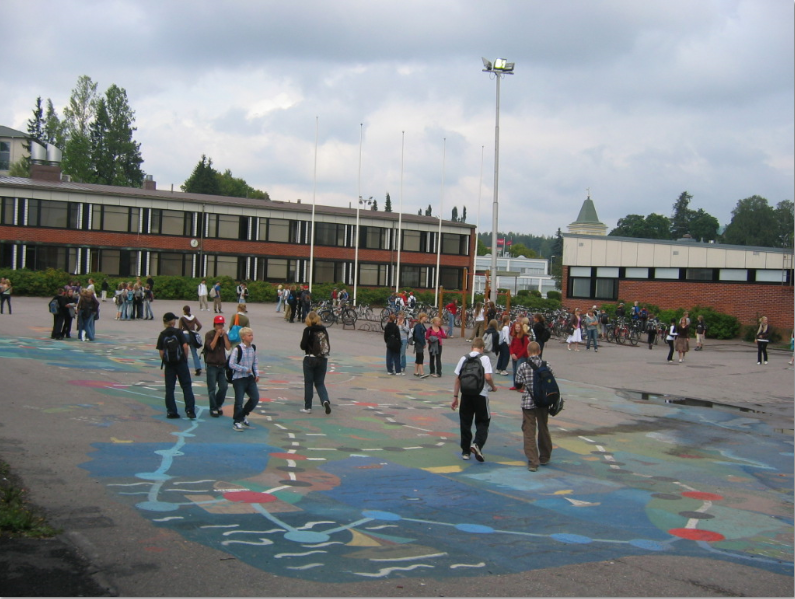
For example plan a outdoors game on the school’s playground. You can move on the game board by the rules student have done themselves or rules like the Star of Africa game.

Students can do the question-answer pairs about the history of their municipality etc. In our school students were working during art, history and math lessons to finish the theme. All classes could play the game during recess or lessons.
Another example of an interdisciplinary theme:
There was a civil war in Mozambique during the years 1976 to1994, and total 1 million people fled to neighbor Malawi. The refugees lived in 145 villages and camps which were spread over 12 regions. Students have to solve how to transport and share the food to refugee camps based on the information they get. This theme was done with the help of Finnish Red Cross.
Today due to conflicts in several countries there may be refugees living near many schools. We have to prepare children to be global citizens in a world where humanity faces challenges such as combating radicalism and terrorism, overcoming poverty, building functional communities, and growing up to be engaged and responsible citizens.